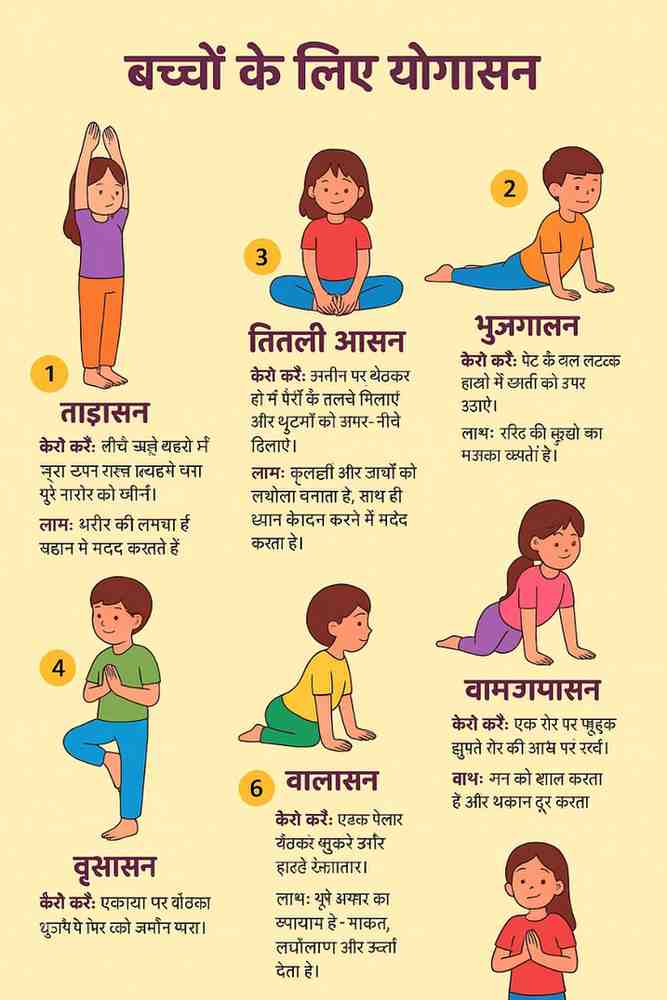
Yoga is an ancient physical, mental, and spiritual practice that originated in India more than 5,000 years ago. The word “Yoga” comes from the Sanskrit word “Yuj,” which means to join or to unite — symbolizing the union of body, mind, and spirit.
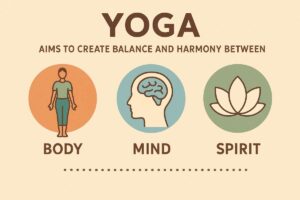
Main Purpose of Yoga
1.BODY –
The body is strengthened and balanced through physical postures, called asanas (आसन).
-
What Are Asanas?
Powerful Asanas are specific body positions or poses designed to:
-
Improve flexibility and strength
-
Enhance balance and coordination
-
Prepare the body for meditation by keeping it steady and relaxed
-
Examples of Powerful Yoga Asanas
- Tadasana (Mountain Pose)
Meaning: “Tada” means mountain — you stand tall and steady like one.
Steps:
-
Stand straight with feet together.
-
Raise your arms overhead and interlock your fingers.
-
Stretch your body upward while inhaling deeply.
-
Hold for a few seconds, then exhale and relax.
-
Repeat these steps again.
Benefits:
- Improves posture,
- balance and blood circulation.
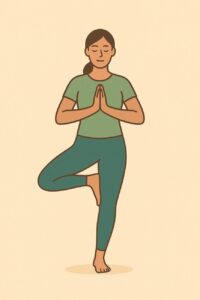
b. Vrikshasana (Tree Pose)
Meaning: “Vriksha” means tree.
Steps:
-
Stand straight on one leg.
-
Place the other foot on your inner thigh.
-
Join your palms in prayer position in front of your chest.
-
Focus on a point ahead and balance.
-
Then relax and repeat these steps again.
Benefits:
- Improves concentration,
- strengthens legs,
- and enhances balance.
c. Bhujangasana (Cobra Pose)
Meaning: “Bhujanga” means cobra — the pose looks like a raised cobra.
Steps:
-
Lie on your stomach.
-
Place palms under shoulders.
-
Inhale and lift your chest upward.
-
Keep elbows slightly bent and look up.
-
Then relax and repeat these steps again.
Benefits:
- Strengthens spine,
- relieves back pain,
- opens chest and lungs.
d. Adho Mukha Svanasana (Downward-Facing Dog Pose)
Meaning: “Adho” = downward, “Mukha” = face, “Svana” = dog.
Steps:
-
Come onto hands and knees.
-
Lift hips up to form an inverted “V” shape.
-
Keep head between arms and heels touching the ground.
- Then relax and repeat these steps again.
Benefits:
-
Stretches spine,
-
arms, and legs boosts blood flow to the brain.
e. Padmasana (Lotus Pose)
Meaning: “Padma” means lotus.
Steps:
- Sit with legs extended.
- Place each foot on the opposite thigh.
- Rest hands on knees and close your eyes.
Benefits:
- Calms the mind,
- improves focus,
- and is ideal for meditation.
2.MIND –
The mind is calmed and focused through breathing techniques, known as Pranayama (प्राणायाम).
-
What is Pranayama?
The word “Pranayama” comes from two Sanskrit words:
“Prana” = life force or vital energy (the breath)
“Ayama” = control or regulation
So, Pranayama means “control of the life force through breath.”
By controlling your breathing, you learn to control your mind, emotions, and energy.
-
How Pranayama Helps the Mind
-
Reduces stress and anxiety
-
Increases concentration and calmness
-
Balances nervous system and emotions
-
Brings mental clarity and inner peace
-
Examples of Common Yoga Pranayama
- Anulom Vilom (Alternate Nostril Breathing)
Meaning: “Anulom” = with the grain, “Vilom” = against the grain.
Steps:
-
Sit comfortably with a straight back.
-
Close your right nostril with your right thumb.
-
Inhale slowly through the left nostril.
-
Close your left nostril with the ring finger and exhale through the right nostril.
-
Repeat the process alternately.
Benefits:
-
Balances both sides of the brain
-
Reduces stress and anxiety
-
Improves focus and mental clarity
b. Bhramari Pranayama (Bee Breath)
Meaning: “Bhramari” means bee — the exhalation makes a humming sound like a bee.
Steps:
-
Sit in a calm place, close eyes.
-
Inhale deeply through the nose.
-
Close your ears with your thumbs and make a humming sound (“mmm…”) while exhaling.
Benefits:
-
Relieves anger, tension, and anxiety
-
Calms the mind
-
Improves concentration and sleep
c. Kapalabhati Pranayama (Skull Shining Breath)
Meaning: “Kapal” = forehead, “Bhati” = shining.
Steps:
- Sit straight and take a deep breath in.
-
Exhale forcefully through the nose while pulling your stomach in.
-
Let inhalation happen naturally.
-
Repeat for 20–30 rounds.
Benefits:
- Cleanses respiratory system
- Improves digestion and energy
- Makes mind alert and active
d. Bhastrika Pranayama (Bellows Breath)
Meaning: “Bhastrika” means bellows — like the rapid blowing of air.
Steps:
Inhale deeply and exhale forcefully through the nose.
Keep rhythm steady and smooth.
Do 10–15 rounds, then rest.
Benefits:
-
Boosts energy
-
Strengthens lungs
-
Reduces mental dullness
- e. Ujjayi Pranayama (Ocean Breath)
- Meaning: “Ujjayi” means victorious.
Steps: -
Inhale slowly through the nose while slightly contracting your throat.
-
Exhale through the nose making a soft ocean-like sound.
Benefits:
-
Soothes mind and body
-
Improves concentration and oxygen flow
-
Great for meditation and relaxation
3.SPIRIT –
The spirit is connected and awakened through meditation, known as Dhyana (ध्यान).
-
What is Dhyana (Meditation)?
Dhyana means deep concentration or meditation — it’s the seventh limb of Patanjali’s Ashtanga Yoga.
It is the stage where the mind becomes still, peaceful, and focused on one thought or the inner self.
It helps us go beyond body and mind to experience inner awareness, peace, and connection with the soul.
Purpose of Dhyana
-
To achieve mental clarity and peace
-
To develop self-awareness and mindfulness
-
To connect with the higher consciousness (Atman)
-
To prepare the mind for spiritual awakening (Samadhi)
Simple Steps for Meditation (Dhyana)
-
Sit comfortably in Padmasana (Lotus Pose) or Sukhasana (Easy Pose).
-
Keep your spine straight and eyes closed.
-
Focus on your breath — feel each inhalation and exhalation.
-
Slowly bring attention to a mantra, like “Om”, or simply observe your thoughts.
-
Let go of distractions and stay present in the moment.
Start with 5–10 minutes daily, then increase gradually.
✨ Benefits of Meditation
-
Reduces stress, anger, and anxiety
-
Improves focus and memory
-
Increases emotional stability
-
Brings inner peace and happiness
-
Leads to spiritual growth